By Kavita Dadhich, resin artist at Varmala Preservation India, Jaipur (working with wedding flowers since 2012). Updated 26 October 2026.
Quick answer: Yes. A well-made resin varmala frame lasts for many years. How long it stays clear and colourful depends on four things: how dry the flowers were, the quality of the resin, how carefully it was poured and cured, and where you keep it. Direct sunlight and heat are the biggest enemies. Keep the frame indoors, away from windows and stoves, and dust it with a soft dry cloth.
- All epoxy resin can slowly turn yellow under UV light. Good resin with UV stabilisers slows this down a lot.
- Dried flowers change colour slightly before resin goes on. After sealing, colours stay much more stable.
- Bubbles, a sticky surface or cloudy patches are signs of poor work, not of resin itself.
You are about to spend real money on a keepsake that should last as long as your marriage. So it is fair to ask: will it still look good in ten years, or will it turn yellow and dull in a year? This guide explains honestly what makes a resin varmala frame last, what makes it fail, and how to look after it.
Table of contents
- How long does a preserved varmala last?
- The four things that decide durability
- Does resin turn yellow?
- Will the flower colours fade?
- Signs of a poorly made frame
- How to care for your resin frame
- Questions to ask any artist before you order
- FAQs
How long does a preserved varmala last?
A resin varmala frame made with fully dried flowers, good resin and careful curing lasts for many years indoors. Resin seals the flowers away from air, moisture, dust and insects, which are what normally destroy dried flowers within months. Nobody can honestly promise an exact number of years, because sunlight, heat and humidity in your home affect every piece differently. What we can tell you is what keeps a frame looking good, and what ruins it.
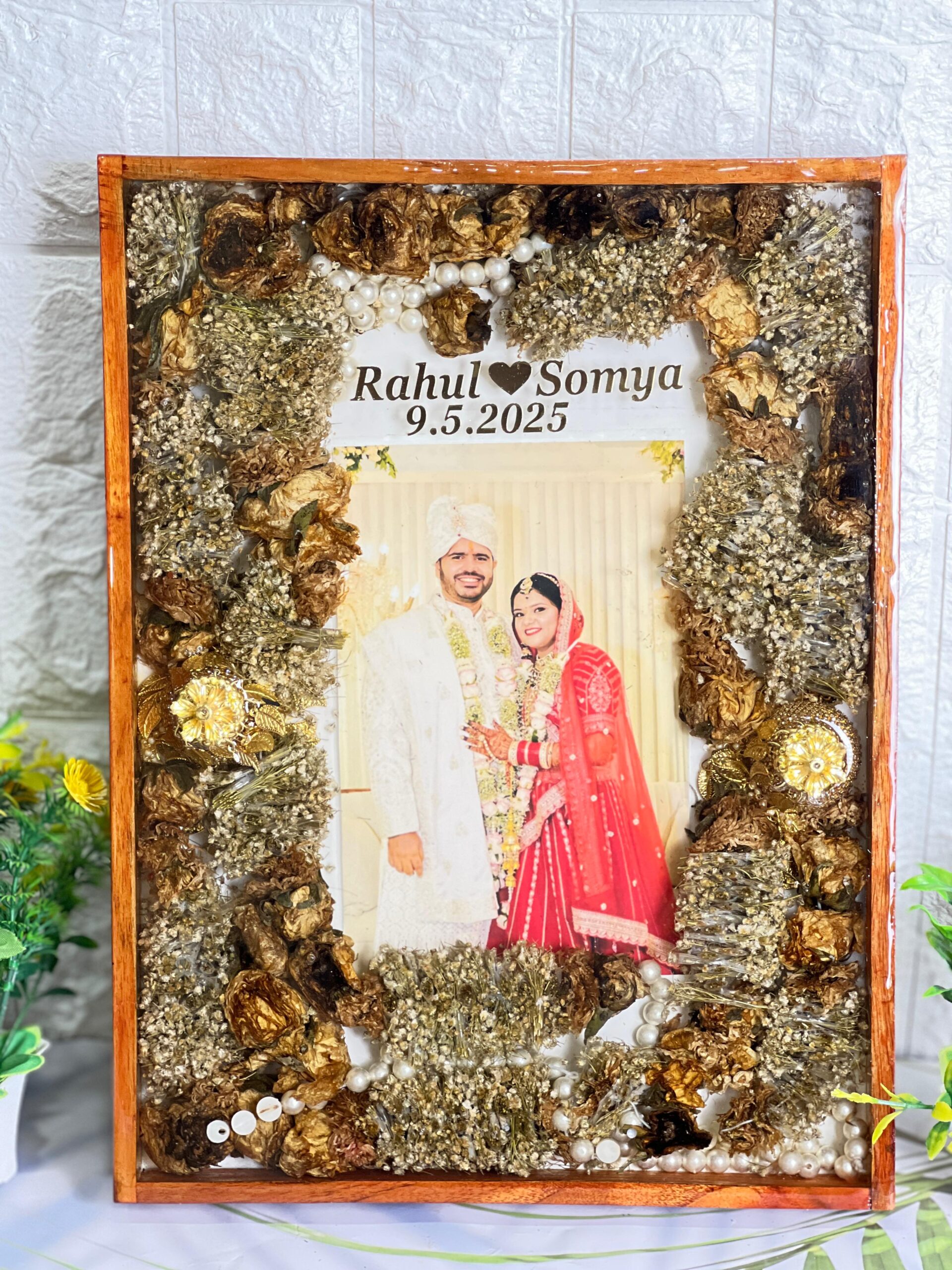
The four things that decide durability
| Factor | Why it matters | What good work looks like |
|---|---|---|
| 1. Dry flowers | Moisture trapped in petals causes browning and fungus inside the resin. | Flowers are fully dried and checked before casting. Damp petals are finished in silica gel. |
| 2. Resin quality | Cheap resin yellows fast and can stay soft or cloudy. | Clear, UV-resistant resin. At our studio we use our own UV-resistant formulation. |
| 3. Pouring and curing | A wrong resin-to-hardener ratio, thick pours or rushed curing cause bubbles, heat damage, cracks or a sticky surface. | Exact mixing, layered pours for deep frames, bubble removal and full curing before polishing. |
| 4. Where you keep it | UV light and heat break down resin over time. | Indoors, away from direct sun, heaters and the kitchen stove. |
Why the resin-to-hardener ratio matters
Epoxy resin is two liquids, resin and hardener, that react and harden together. If the ratio is off, part of the mix never fully hardens. The surface stays slightly sticky, attracts dust and can turn cloudy. This is one of the most common problems with rushed or low-cost work, and it cannot be fixed later.
Does resin turn yellow over time?
Yes, all epoxy resin can slowly turn yellow, mainly because of ultraviolet (UV) light. Resin without UV protection can yellow visibly within a few months. Resins with UV stabilisers and light stabilisers (often called HALS) slow this down a lot, but no resin is completely yellow-proof. That is why where you keep the frame matters as much as the resin we use.
In practice, a quality frame kept indoors and out of direct sunlight stays clear for years. A frame placed on a sunny windowsill or a balcony wall will age much faster, whoever made it.
Resin makers explain that UV light is the main cause of yellowing, and that stabilisers slow it but cannot stop it completely. (Source: ArtResin)
Will the varmala flower colours fade?
Flowers change colour mainly during drying, before any resin is poured. Deep reds usually darken, pinks soften and white flowers can turn creamy. You see these real dried colours on video before we pour, so you know exactly how your frame will look.
Once the flowers are sealed, colour changes slow down a lot. Strong sunlight can still fade petals slowly through the resin, which is another reason to keep the frame out of direct sun. We cover this topic in detail in does preserved flower colour fade inside resin frames.
A note on screens: colours on a phone screen never match a handmade piece exactly. Lighting and screen settings change how flowers look in photos, so expect the real frame to look a little different from pictures.
Signs of a poorly made frame
- Many air bubbles around the flowers, especially large ones on the surface.
- A sticky or soft surface weeks after delivery, which means the resin did not cure properly.
- Cloudy or milky patches around petals, often from moisture or poor curing.
- Brown or black spots spreading inside the resin, which point to flowers that were not fully dry.
- Cracks or rough, unsanded edges.
- Yellow resin on arrival, a sign of old hardener or low-grade resin.
Small marks of handwork, like a tiny bubble deep inside or a slightly uneven corner, are normal in handmade resin. Large or spreading defects are not.
How to care for your resin varmala frame
- Keep it out of direct sunlight. Choose a wall that does not get sun through a window.
- Keep it away from heat. Avoid spots above a stove, near a heater, or next to a lamp that gets hot.
- Avoid humid rooms. Bathrooms are not a good place for resin frames.
- Dust with a soft, dry microfibre cloth. Do not use alcohol, glass cleaner or harsh chemicals; they can dull the shine.
- Handle with care. Resin is strong but can chip or crack if dropped. Hang it with a secure hook.
- For LED pieces, use the adapter that came with it and switch it off when not needed.
Is epoxy resin eco-friendly?
Epoxy resin is a type of plastic. Once cured it is stable, but it does not break down like natural materials. Our view is honest: a single keepsake you keep for decades is a small, long-lived use of resin, very different from single-use plastic. If being plastic-free matters most to you, consider dry-pressed flowers in a glass frame instead. Our comparison of dry vs epoxy resin varmala preservation explains the trade-offs.
Questions to ask any artist before you order
Whether you choose us, another studio or an Instagram artist, ask these questions. A good artist answers them clearly.
- How do you dry the flowers, and how do you check they are fully dry?
- What resin do you use, and does it have UV protection?
- Will you show me the flowers and the design before you pour resin?
- How long do you let the resin cure before polishing and dispatch?
- How do you pack the frame for courier, and what happens if it breaks in transit?
- Can I see real customer reviews and photos of finished frames that are a year or more old?
We explain why these steps affect the price in why some artists charge more for varmala preservation and why we always choose high-grade resin.
Frequently asked questions
Will my varmala frame turn yellow?
All epoxy resin can yellow slowly under UV light. UV-resistant resin and keeping the frame out of direct sunlight keep it clear for years.
Can a resin frame break?
Resin is strong, but it can chip or crack if dropped on a hard floor. Hang it securely and handle it with both hands.
Can fungus grow inside a resin frame?
Only if the flowers were not fully dry before casting. That is why drying is the most important step. Read how to dry a varmala before preservation.
Can I clean the frame with water?
Wipe it with a soft dry cloth. If needed, use a cloth that is very slightly damp and dry it straight away. Never soak the frame or use chemical cleaners.
Can I keep the frame in a room with an AC or a heater?
An air-conditioned room is fine. Keep the frame away from direct heat sources such as heaters, stoves and hot lamps.
Make it last
A long-lasting varmala frame starts with fully dried flowers and good resin, and ends with the right spot on your wall. If you want a frame built to last, see our varmala photo frames or talk to our team about your flowers. We show you every step before the resin is poured.